AI Agent Architecture: Why Bridgewater Treats Agents as Compilers
 Dennis Zagiansky9 min read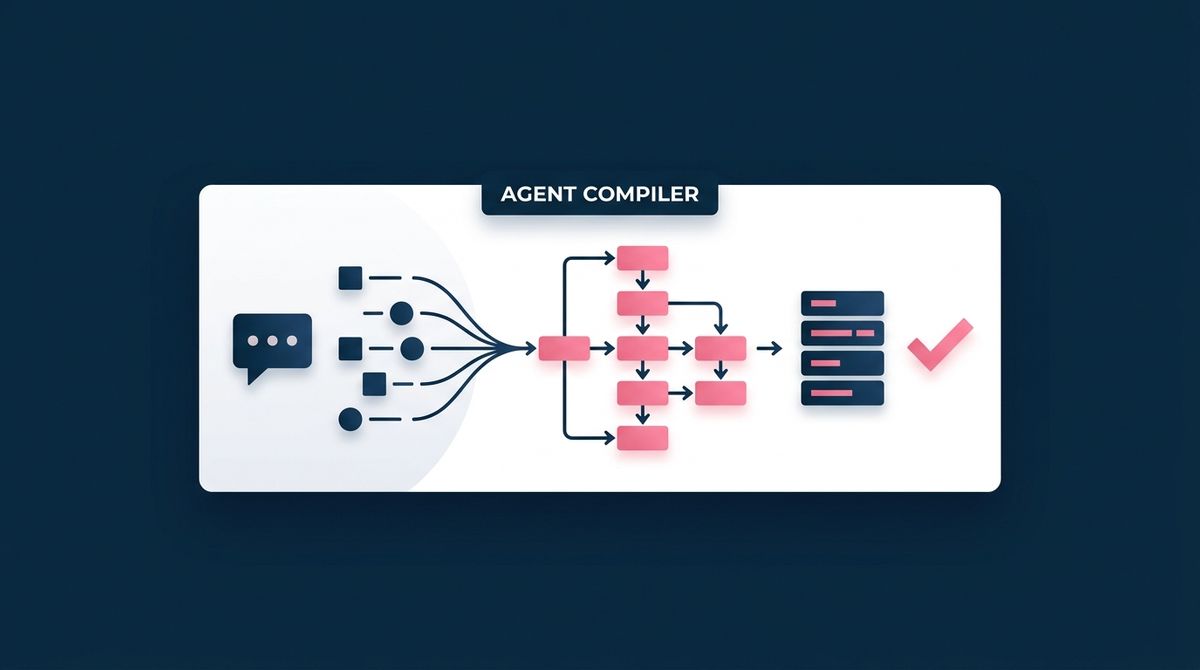
"We have to wait four minutes for this research plan to run," a developer on our team muttered, staring at the terminal. "And if step twelve fails, we have to start the entire run over."
If you are building complex AI agents, you have probably heard or said some version of this. We default to building agents as sequential chat loops where the LLM generates a step, calls a tool, reads the output, and then decides what to do next. But when you scale this pattern to heavy enterprise workloads, the chat loop breaks. It is too slow and too fragile to run at scale.
In LangChain's architectural teardown of Bridgewater's Pocket Analyst Tool (PAT), we get an excellent example of how to solve this. Instead of treating agents as conversational chatbots that write and run code step-by-step, Bridgewater treats them like compilers. This architectural shift from sequential chat loops to robust agentic workflows is redefining how we build production-grade AI.
The system is deployed to hundreds of investors, compressing hours of financial research into minutes. By moving from a conversational loop to a compilation pipeline, Bridgewater changed how they think about agentic code generation.
Why the Chat Loop is a Dead End
When we build standard agents, we rely on the model to act as both the planner and the executor in real time. The model writes some Python code, executes it in a sandbox, looks at the stdout, and then writes the next block.
This runtime-heavy approach is highly fragile. In our own work, we call this the AI agent failure modes trap, where a single failure in a long chain of tool calls ruins the entire execution run. If step twelve of a fifteen-step research plan fails, the agent has to start from scratch or try to recover in a messy, unstructured state.
Sequential execution also creates massive latency. If every step depends on the LLM reading the output of the previous step, your latency scales linearly with the complexity of the task.
Bridgewater's insight was to decouple the planning phase from the execution phase. Instead of running code line-by-line during the generation phase, they treat the LLM as a compiler that translates a high-level user request into a structured execution plan.
The Compiler Paradigm for AI Agent Architecture
To understand this shift, think about how a traditional software compiler works. It does not run your program while compiling it. It takes your source code, parses it, builds an abstract representation of the execution flow, optimizes it, and then outputs a compiled binary that can run deterministically.
Bridgewater's PAT architecture works the exact same way. It uses three core pillars to turn research requests into compiled plans:
- Parallel code generation from structured plans.
- DAG-based validation agents.
- A static analysis caching layer for near-instant re-runs.
To see how these two architectures stack up, here is a comparison between conversational chat loops and compiler-style agent architectures:
- Chat-Loop Agents:
- Execution style: Sequential and line-by-line.
- Reliability: Brittle, where a single mid-route failure breaks the entire run.
- Latency: Linear, scaling up with every additional task or tool call.
- Caching: Difficult or impossible due to non-deterministic chat histories.
- Compiler Agents:
- Execution style: Parallel and plan-first.
- Reliability: Validated upfront, catching errors before execution starts.
- Latency: Constant, running independent sub-tasks concurrently.
- Caching: Deterministic, reusing previous execution nodes via static analysis.
If you are implementing this in your own stack, you do not have to build these compilers from scratch. Modern orchestration frameworks are evolving to support this exact pattern. For instance, LangGraph allows you to model agentic flows as state graphs with explicit nodes and edges, making Directed Acyclic Graph (DAG) validation straightforward. Similarly, tools like Amazon Bedrock Inline Agents can help orchestrate structured, multi-step tasks by separating planning from execution. The core architectural goal remains the same: move away from unstructured conversational loops and toward defined, verifiable pipelines.
1. Parallel Execution in Agentic Workflows
In a traditional chat loop, if a research plan has twenty sub-tasks, the agent executes them one after another. If each task takes ten seconds, the entire run takes over three minutes.
With a compiler architecture, the planner agent generates a complete, structured execution plan first. This plan is represented as a DAG where the nodes are individual tasks (like fetching a specific time series or running a regression) and the edges represent dependencies between those tasks.
Because the entire plan is defined upfront, the compiler acts as the orchestration layer. The execution engine can immediately identify which tasks are independent of one another. If task A and task B do not share dependencies, the engine runs them in parallel.
The impact is immediate. Parallel code generation allows a 3-task research plan and a 20-task research plan to execute in the exact same amount of time. By eliminating the sequential latency penalty, the system scales to complex research workflows without blowing up the user's wait time.
2. DAG-Based Validation for Agent Reliability
How do you ensure that a compiled plan is actually correct before you run it? If the compiler outputs garbage code, the execution will fail.
Bridgewater solves this by using dedicated validation agents that perform static analysis on the generated DAG. These validation agents do not run the code; instead, they inspect the plan against strict rules and historical context.
To ground these validation agents, Bridgewater draws on 50 years of written-down investment logic. This massive repository of domain expertise is injected into the context window, giving the validation agents a precise rubric for what a high-quality financial research plan looks like.
If the validation agent detects a logical error or a missing step in the compiled plan, it sends it back to the planner with specific feedback. The plan is recompiled before a single line of execution code is run.
This shift from runtime trial-and-error to compile-time validation is why Bridgewater's time series search with human-like inspection jumped from 50% to 90% accuracy.
We see this often when helping teams build AI products. Evaluating the final output of an agent is not enough. As we argue in our guide on why output-only evaluations fail, you must monitor the intermediate steps and trajectories. By monitoring agent trajectories, you catch logic errors before they waste compute or return hallucinated results.
3. Deterministic Caching and Static Analysis
One of the biggest issues with standard chat-loop agents is that they are completely non-deterministic. If a user asks the same research question twice, the agent will generate two different chat histories, make different tool calls, and take just as long to execute the second time.
Compilers solve this through caching. If you compile a program and run it, and then compile it again without changing the source code, the compiler can reuse cached build artifacts.
By treating agentic code generation as a compiler problem, Bridgewater enabled deterministic caching. The execution engine performs static analysis on the compiled DAG. If a specific sub-task (for example, calculating the rolling correlation of two assets over ten years) has already been executed with the same parameters, the engine skips the execution and pulls the result directly from the cache.
This means that if an investor modifies a small part of a 20-step research plan, the system does not need to re-run the other 19 steps. The re-run is near-instant because the unchanged nodes in the DAG are loaded from the cache.
This is a substantial win for both user experience and unit economics. It prevents the system from burning expensive API tokens on repetitive work.
Why Modern AI Agent Architecture Requires a Compiler Pattern
The success of Bridgewater's PAT architecture shows that the future of complex enterprise agents is not necessarily conversational. Chat is a great interface for discovery, but it is a terrible execution model for complex workflows.
When you build agents as compilers, you gain three major advantages:
- Predictable Latency. Parallel execution decouples latency from the number of tasks, meaning complex research does not mean longer wait times.
- Structural Correctness. Static validation catches logical errors before execution, driving accuracy up to 90%.
- Cost Efficiency. Deterministic caching ensures you never pay to run the same sub-task twice.
If you are an AI product manager or engineering lead building multi-step agents, it is time to stop thinking about how to make your chat loop smarter. Instead, think about how to build a better compiler. Optimizing these systems requires managing the unit economics of AI agents carefully, especially when scaling to production workloads where token costs can quickly compound.
Frequently Asked Questions
- What is a compiler-style AI agent?
A compiler-style AI agent separates the planning phase from the execution phase. Instead of generating and running code step-by-step in a real-time conversational loop, it translates a high-level user request into a complete, structured execution plan (like a DAG) before running any code.
- How does parallel execution improve agent speed?
Because the entire execution plan is generated upfront as a DAG, the system's orchestration layer can analyze dependencies. Any tasks that do not depend on each other can run concurrently. This decouples execution latency from the sheer number of sub-tasks, keeping wait times low.
- Why use a DAG for AI agent planning?
A Directed Acyclic Graph (DAG) clearly maps out the dependencies between individual agent tasks. This allows for static analysis, parallel execution of independent nodes, and targeted validation. It also enables deterministic caching, meaning unchanged nodes can be loaded from cache rather than re-executed.
The Bottom Line
Treating AI agents as sequential chat loops limits their speed and reliability at scale. By separating planning from execution and compiling research goals into structured, parallel DAGs, you can build deterministic, highly cached systems that perform complex tasks in minutes instead of hours. This shift from conversational demo-ware to compilation pipelines is essential for achieving production-grade reliability at scale.