The Future of AI Product Management: Building Self-Improving Products
 Itamar Kramer7 min read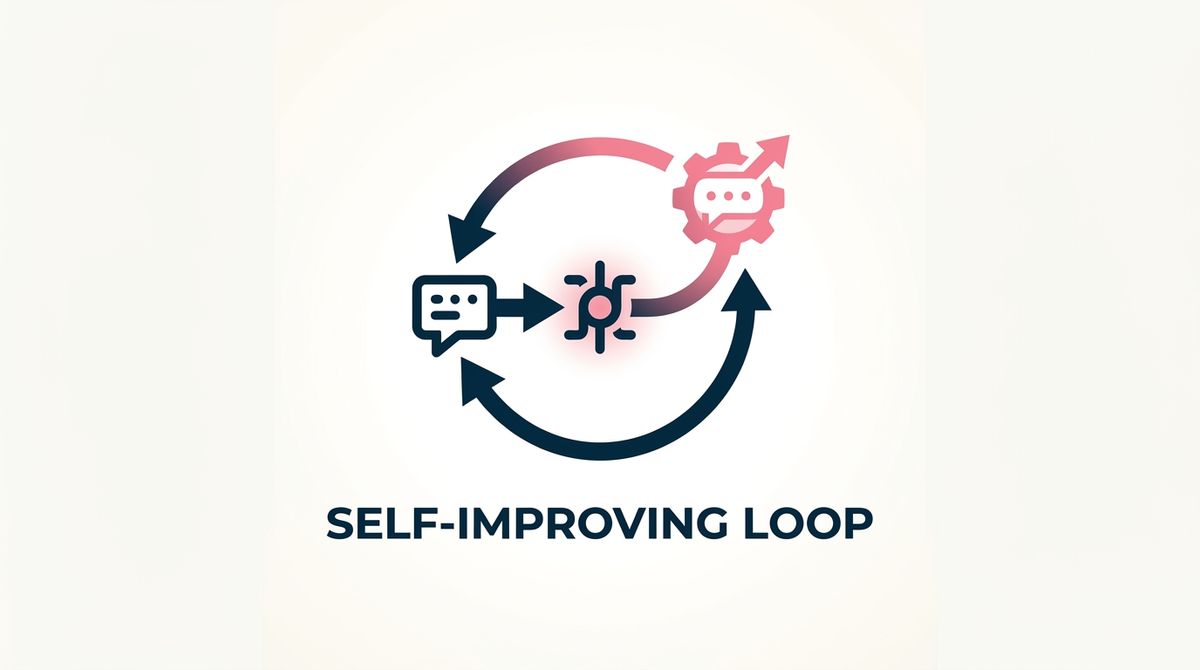
"We just shipped a fix for the checkout drop-off."
"Who wrote the PR?"
"An agent. And it was another agent that decided we needed it in the first place."
This conversation is rapidly becoming reality. For decades, software development followed a rigid, linear pipeline. Telemetry gathered data, product managers analyzed dashboards, engineers wrote specs, and developers wrote code. It was a slow, manual process driven entirely by human decision-making at every step.
That linear model is starting to break. We are entering the era of the self-improving product: software that autonomously monitors its performance, decides on fixes, and deploys them. In this new era of AI product management, the goal shifts from shipping features to building autonomous systems that learn from user intent.
This is not a distant concept. YC partner Tom Blomfield has been talking about agent swarms that watch a product, spot gaps, and ship fixes with little human input.
The early numbers are still modest. As Department of Product reported, Amplitude says only about 11% of the feature suggestions its agent generates actually ship. That says a lot about where things stand. Coming up with ideas is the easy part. Knowing which ones are worth shipping, and whether they worked, is still hard.
We always assumed human judgment would always own the deciding layer of product management. We thought agents would just be tools to write code faster. But as agents start writing their own technical specs based on raw analytics data, the bottleneck shifts. The hard part is no longer writing the code. The bottleneck is orchestrating and evaluating the loop itself.
The AI Agent Architecture of Self-Improving Products
Building a self-improving product requires moving past simple, ad-hoc scripts. It requires a continuous, closed-loop system. Rich Holmes at Department of Product breaks this AI agent architecture for products into five parts:
- Product Map: A machine-readable graph of user states, core metrics, and system constraints. This replaces traditional static site maps, serving as the rails that keep the system aligned with business goals. If the agent does not understand the relationships between different parts of the product, it will make decisions that optimize one metric at the expense of another.
- Sense: Raw, structured event streams. Traditional aggregated dashboards are built for human eyes, but agents need granular event logs to understand exactly where a user journey broke down. They need to know what the user tried to do, what the system did in response, and where the breakdown occurred.
- Decide: Scoring opportunities and writing technical specifications. The agent analyzes the event streams, identifies friction points, and drafts detailed requirements to resolve them. This is not just about identifying bugs. It is about identifying feature gaps and drafting the exact requirements.
- Act: Routing the generated task to execution tools. This could be Claude Code opening a pull request or Jira creating a ticket for human review.
- Learn: Measuring post-deployment impact to update the system's memory. The system monitors whether the change resolved the issue without introducing new errors, writing these results back into its long-term memory to improve future decisions.
Why the AI Product Manager Role is Shifting to the "Deciding Layer"
For years, the "Sense" and "Act" layers had some automation, but "Decide" was the sacred ground of human product managers. PMs spent hours analyzing charts and writing technical specs.
Why is this changing? Because generative models can now synthesize unstructured user feedback and structured telemetry to build a coherent technical spec. They can spot patterns across thousands of customer interactions that a human PM would miss.
But there is a catch. If you turn agents loose on traditional SaaS metrics, they struggle. This is because traditional SaaS metrics fail to capture agent behavior and user intent inside probabilistic systems. A self-improving product needs a much deeper understanding of how its underlying agents are performing, where they are failing, and how users are reacting.
The New Bottleneck: Orchestrating Autonomous Feedback Loops
If code generation is cheap and autonomous, the bottleneck shifts to orchestration. How do we ensure the agent does not ship a fix that breaks other things?
We cannot rely on traditional QA anymore. When agents are rewriting code, evaluating these loops based on output alone is a major risk. A pull request might pass its unit tests but completely ruin the user experience or introduce silent failures. Doing an AI agent evaluation based on raw outputs is no longer enough. We must evaluate the entire trajectory of the agent's decisions.
To make self-improving products reliable, we need dedicated infrastructure to act as the referee. This is why we built Brizz as AI agent analytics built specifically for autonomous workflows. When your product is continuously modifying itself, you need 100% visibility into every loop and decision.
How AI Product Management Redefines the PM Career Path
As the deciding layer moves to AI, the day-to-day role of the AI product manager changes completely. You are no longer writing Jira tickets or manually managing backlogs.
This shifts the entire Product Development Lifecycle (PDLC). Traditional PDLC is a slow, batch-processed cycle of roadmap planning, spec writing, two-week sprints, and staging tests. With autonomous product development, the PDLC becomes a real-time, continuous loop where the system constantly senses friction, deploys fixes, and measures results. The traditional release cycle disappears.
This changes the core skills required for the AI product manager role. Instead of being a builder who manages individual features, you become a conductor. Your primary responsibility is defining system boundaries. You set the guardrails, define the success metrics in the Product Map, and audit the decisions made by the agent swarm. PMs must transition from designing static features to designing the dynamic systems that optimize them.
How to Prepare Your Stack for Autonomous Product Decisions
How do AI PMs and engineering leaders prepare for this future? Here is how to start building the foundation today:
- Expose raw telemetry, not just pre-aggregated dashboards. Agents need access to granular events to understand context.
- Standardize the technical specification schema. Define exactly how an agent should write a PRD or technical spec so downstream code agents can consume it reliably.
- Build robust sandbox environments. A self-improving product must have a safe playground to test its changes before hitting production.
- Implement semantic evaluation. Track not just whether code compiled, but how the user's semantic journey changed after the deployment.
Frequently Asked Questions
What is a self-improving product?
A self-improving product is software that autonomously monitors its own performance, identifies areas of user friction, decides on solutions, and deploys code changes without requiring manual human intervention.
How does AI change the product manager role?
The AI product manager role shifts from writing specifications and managing backlogs to defining system boundaries, setting success guardrails, and orchestrating autonomous loops. PMs transition from feature builders to system conductors.
What is the 5-part architecture for AI agents in products?
The five-part AI agent architecture for products consists of:
- Product Map: Defining core metrics and system boundaries.
- Sense: Collecting raw, structured event streams.
- Decide: Identifying friction points and writing technical specifications.
- Act: Deploying code or routing tasks to execution tools.
- Learn: Measuring post-deployment impact to update the system's memory.
The Bottom Line
The future of software is not just faster code generation; it is the automation of the entire product feedback loop. As agents take over the deciding layer, the role of product and engineering leaders shifts from manual feature building to loop orchestration. Success in this new era requires a robust analytics and evaluation infrastructure that acts as the system's referee.