AI Agent Analytics: Why Traditional SaaS Metrics Fail
 Daniel Shapira9 min read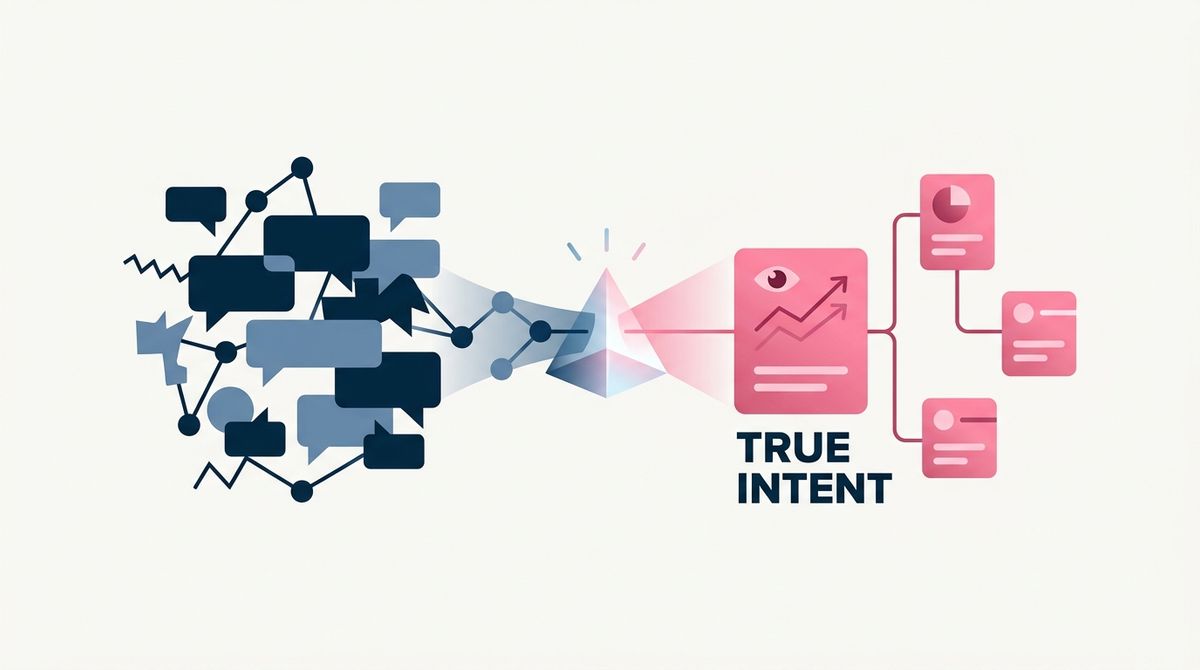
"Why did our AI dashboard fail?"
"Because we built it like a traditional SaaS tool. We sliced all our user data by industry, and it turned out to be completely useless."
During a recent scoping conversation with our team, an AI product leader at a major enterprise work-management platform shared this candid realization. They had spent months building an internal monitoring tool, a sort of "Gong for products" designed to track how users interacted with their agentic features. But when they rolled it out to product managers, the dashboard was a ghost town. The data was there, but the insights were missing.
The team had done what any experienced SaaS builder would do. They organized their analytics by industry, CRM versus construction, expecting to see clear patterns. Instead, they found that these traditional demographic cuts were completely irrelevant to how users actually interacted with their AI. A failure in an agentic workflow was a product gap, and it did not care whether the user was managing a construction site or a sales pipeline.
To understand why this happens, we must look at the difference between traditional product analytics and the emerging world of AI agent analytics.
In traditional software, tools like Mixpanel or Amplitude rely entirely on structured events, such as button clicks, page views, or form submissions. The user journey is a static map of pre-defined UI paths. AI agent analytics, however, must parse unstructured conversational data. Transitioning to conversational analytics allows us to understand what users actually want by processing their natural language inputs.
There is also a critical distinction between agent observability and product analytics. Engineers use agent observability tools like LangSmith, Datadog, or LangFuse to monitor technical traces, track latency, and count tokens. These are essential for debugging infrastructure. But product managers need something different. They need to understand user journeys, adoption patterns, and actual business outcomes. This shift from technical monitoring to strategic product insights is driving the rise of product-led AI.
The Trap of Legacy SaaS Dimensions in AI Agent Analytics
For the past fifteen years, product analytics tools have trained us to think in terms of user cohorts. We slice our data by annual recurring revenue, company size, or industry. In traditional SaaS, this approach makes perfect sense. User journeys are highly structured, predictable, and deterministic. If users at mid-sized construction firms are dropping off during onboarding, you probably have a construction-specific template issue or a confusing form field. The software itself is a static map of buttons and drop-downs.
Consider a traditional CRM workflow. A user clicks "Create Lead," fills in four structured fields, and clicks "Save." If they drop off, you can track the exact field that caused the friction. If that friction occurs mostly in the healthcare sector, your product team knows exactly where to look. The demographic slice directly correlates with the user's workflow because the workflow was designed for that demographic.
AI agents change this dynamic completely. When a user interacts with an AI agent, they are not clicking through a pre-defined path. They are using natural language to negotiate a task. The interface is conversational and dynamic. The user might type, "Find all leads from yesterday that mentioned budget issues and draft a follow-up email."
In this environment, traditional demographic slicing becomes a distraction. An AI agent does not fail because a user works in finance rather than healthcare. It fails because it misunderstands a prompt or fails to execute a specific API call. A breakdown in an agentic action is a fundamental product gap. Slicing that failure by company size or industry only dilutes the signal, making it harder for product managers to see what is actually broken. This is where legacy SaaS dimensions fail. To build successful agentic workflows, you need to measure what the user is actually trying to do.
The New Model: Measuring Agent Performance via Intent
To solve this, the product team at the work-management platform is shifting to a new analytical framework. Instead of grouping user sessions by account demographics, they group agent interactions strictly by user intent and sub-intent.
This shift allows product managers to look across the entire user base and see the performance of specific actions. The new model acts as a multi-dimensional matrix where the primary axis is what the user is trying to accomplish, rather than who the user is. By focusing on intent, you can track three critical states for every user goal to measure agent performance:
- Pass: The agent understood the intent and successfully completed the task.
- Fail: The agent understood the intent but failed to execute it correctly.
- Breakdown: The agent completely misunderstood the intent, leading to a dead end.
When you organize your data this way, the path to product improvement becomes obvious. If your agent fails forty percent of the time when a user tries to generate a project schedule, that is your primary product gap. It does not matter if those failures are spread across marketing agencies, software companies, or construction firms. The underlying issue is the agent's inability to handle that specific intent. Slicing by industry would only scatter those failures across ten different dashboards, hiding the systemic issue.
Why Generic Intent Classification Fails Your Product Roadmap
Once you decide to track user intent, the next challenge is how to categorize those intents. Many teams try to take a shortcut here by using generic, out-of-the-box LLM labeling. They dump their user prompts into a basic classifier and let it assign broad categories.
During our conversation, the product team warned that this approach quickly falls apart. In one instance, a generic auto-categorization model labeled a complex, highly specific business intent as a mere "Notification."
In reality, the user was trying to perform a sophisticated action that the team called a "Fair Partition," which is a method for distributing tasks equitably among team members. By labeling it as a "Notification," the generic system completely missed the user's actual goal. This created a false bias in the data, making it look like users were simply asking for alerts when they were actually trying to execute complex operational workflows.
Generic labels hide the nuance of your product. Using generic LLM-as-a-judge models for intent classification is also expensive at scale and highly inaccurate. Custom intent taxonomies are more cost-effective and accurate than generic LLM-as-a-judge models. To build a useful intent-based dashboard, you must define intents that map directly to your product's unique capabilities and user goals.
4 Steps to Building an Intent-Based AI Agent Analytics Framework
Transitioning from legacy SaaS metrics to intent-based analytics requires a shift in how you design, collect, and analyze your product data. Here are four practical steps to implement this approach in your agentic products:
1. Instrument for Action Outcomes
Traditional analytics track page views, clicks, and session lengths. For AI agents, these metrics are often misleading. A long session might mean high engagement, or it might mean a frustrated user is stuck in a loop with a confused chatbot. Instead, instrument your system to track the outcome of specific actions. Did the agent successfully call the API? Did the user accept the generated output, or did they have to edit it manually? Track these outcomes as explicit Pass, Fail, or Breakdown events tied to each user intent.
2. Tracking Resolution vs. Completion
A completed workflow does not mean a resolved user problem. An agent might complete ten steps and call several APIs, but if the user has to manually rewrite the output, the agent failed to resolve the intent. You must measure whether the user's primary goal was actually achieved, rather than simply tracking whether the agent reached the end of its execution tree.
3. Measuring Intent Accuracy
You need to know whether the agent correctly identified what the user wanted in the first place. If a user asks for a project schedule and the agent starts drafting an email, the execution might run perfectly, but the intent classification was wrong. Measuring intent accuracy separates understanding from execution, allowing your team to pinpoint whether the issue lies in your natural language processing or your backend APIs.
4. Deprioritize Demographic Cohorts in Your Core Dashboards
Move ARR and industry to the background. While these dimensions are still useful for marketing and sales, they should not dictate your product roadmap. Your primary product dashboard should show a list of your top user intents, ranked by volume, alongside their respective success rates. This immediately tells your engineering team where to focus their efforts to have the greatest impact on user experience.
Frequently Asked Questions About AI Agent Analytics
What is AI agent analytics?
AI agent analytics is the practice of measuring, analyzing, and optimizing how users interact with AI agents and agentic workflows. Unlike traditional product analytics that track clickstreams, AI agent analytics parses unstructured conversational data to understand user intent and evaluate whether the agent successfully resolved the user's goal.
Why is intent-based slicing better than demographic slicing?
Traditional demographic slicing by industry, company size, or ARR is irrelevant to how an AI agent performs. An AI agent fails because of a misunderstanding of a prompt or a breakdown in tool-calling, which is a fundamental product gap. Slicing by intent groups interactions by what the user actually tried to achieve, allowing product teams to see systemic failures across the entire user base rather than scattering them across irrelevant demographic categories.
The Bottom Line
Slicing AI agent analytics by traditional SaaS dimensions like industry obscures the real behavioral failures of your product. To build agentic tools that actually work, product teams must shift to an intent-based analytics model that measures the success and failure of specific user actions. By grouping data by user intent rather than demographic cohorts, we can quickly identify and fix the systemic product gaps that matter most.