LLM as a Judge: Why Eval Scores Fail Your AI Roadmap
 Dennis Zagiansky8 min read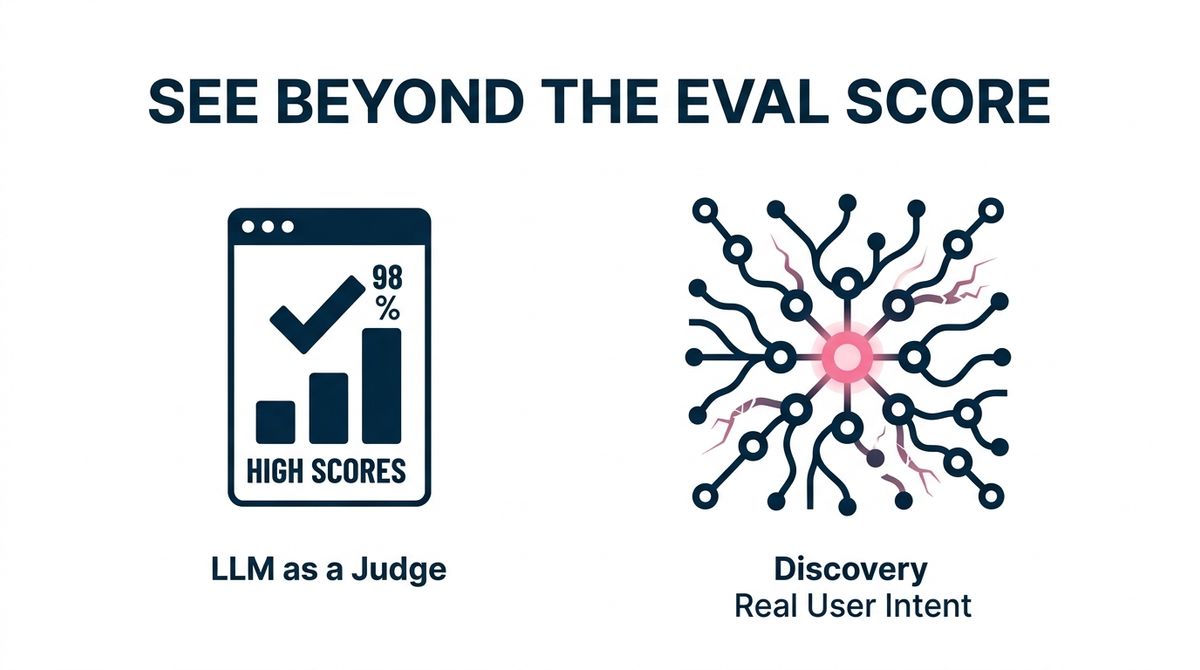
"Our helpfulness score is 4.7 out of 5, and the LLM-as-a-judge says our hallucination rate is under two percent."
"Then why is our day-30 retention still flat at twelve percent?"
We hear this conversation on repeat. Over the last few months, we have talked with dozens of AI product managers and engineering leads building conversational agents, search tools, and support bots. On paper, their evaluation suites are green. In reality, their users are quietly slipping away after their first session.
This is the LLM-as-a-judge trap. It is the comfortable assumption that because an automated grader approves of your agent's responses, your users must be getting value. But there is a massive gulf between an agent that is technically compliant and an agent that is actually useful. When teams rely solely on an LLM as a judge to guide their roadmap, they confuse safety with utility.
The Eval Illusion: Why LLM evaluation metrics are defensive
Evals are designed to prevent regressions. They are unit tests for LLMs, answering critical safety and quality questions: Did the agent hallucinate? Was the tone polite? Did it output valid JSON? Standard LLM evaluation metrics like hallucination rates, toxicity levels, and politeness are defensive. They are critical for establishing a baseline of trust and keeping your agent from behaving badly in production.
While LLM judges aim to automate human evaluation, they operate on static criteria. They grade the response against a pre-defined set of rules, but they cannot tell you if the user actually achieved their goal. If your agent starts hallucinating pricing or using offensive language, your evals will catch it. This is defensive engineering at its finest.
But evals are fundamentally defensive. They tell you if your agent is behaving badly, not if your agent is building a product people want. Frameworks like RAGAS or LangSmith are excellent for this defensive layer: they help you run regression tests, track latency, and monitor cost. But they are not designed for "offense." They cannot show you where users are hitting a wall because a capability simply does not exist on your product roadmap.
Why "Perfect" Eval Scores Hide Product Failure
When product teams rely on LLM judges to guide their roadmap, they use a defense system to design an offensive strategy. An LLM judge can grade a conversation on a scale of 1 to 5, but it cannot tell you what features to build next.
This creates a high cost of ignorance. Teams spend weeks of expensive engineering time prompt-engineering, fine-tuning, or optimizing system prompts to nudge a helpfulness score from 4.2 to 4.7. But if users are leaving because the agent lacks a core capability, that optimization is pure technical debt. You are perfecting a response that your users ultimately find useless.
Example: The Order Cancellation Blind Spot
Let's look at a concrete example. Imagine a customer support agent for an e-commerce brand. A user logs in and asks, "Can you cancel my order #10492?"
The agent is not connected to the order management system. It has no API access to cancel orders. So, it responds:
"I apologize for the inconvenience, but I do not have the ability to cancel orders directly. To cancel your order, please email support@example.com or call our helpline at 1-800-555-0199 between 9 AM and 5 PM EST."
Now, run this interaction through an LLM judge. The LLM judge follows a static rubric or G-Eval framework, using prompts as rubrics to evaluate the response based on standard criteria:
- Accuracy: 5/5 (The agent correctly stated its limitations and provided accurate contact info).
- Politeness: 5/5 (The agent apologized and used a professional tone).
- Relevance: 5/5 (The agent addressed the cancellation request directly).
The average score is a perfect 5/5. The dashboard lights up green. The engineering team celebrates.
But what was the user's experience? The user wanted to cancel an order. Instead, they were given a chore. They had to leave the chat, write an email, or make a phone call. From the user's perspective, the agent failed. They wanted self-service resolution; they got a redirection.
If the product manager only looks at the 5/5 eval score, they see a highly successful interaction. They completely miss the fact that "order cancellation" is a high-frequency user intent that the agent cannot handle. They miss the most important feature request on their roadmap because their LLM evaluation metrics are optimized for compliance, not customer satisfaction.
Moving From LLM Judges to AI Intent Discovery
A 1-5 score is a dead end for product discovery. It is an aggregate metric that flattens the rich, messy reality of user behavior into a single, sterile number. When you look at a dashboard that says "Helpfulness: 4.2/5," you have no actionable next step. Do you prompt-engineer the agent to be 5% more helpful? Do you switch to a larger LLM? None of these actions solve the root problem if the root problem is a missing capability.
To build a product roadmap, you need to move from grading to understanding. You need to understand the unstructured reality of what users are trying to achieve. This requires shifting your focus from the agent's output to the user's input.
Instead of grading a random sample of 100 conversations with an LLM judge, product teams need to extract and aggregate user intents across the entire unstructured dataset. When you analyze 100% of your user interactions, you can see the exact delta between what users expect your agent to do and what it is actually capable of doing.
4 Best Practices for AI Product Discovery
To move past the eval trap, teams need to change how they analyze conversational data. Here are four practical guidelines we recommend:
- Don't treat evals as product analytics. Evals are for quality assurance and regression testing. Analytics are for understanding user behavior and identifying opportunities. Keep them separate. Don't confuse RAG evaluation with product analytics. If you want to build a better roadmap, you need AI agent analytics that track user behavior, not just system compliance.
- Do analyze 100% of your conversations, not just a sample. Sampling is fine for manual grading, but it misses the long tail of user intents. You need to process every single interaction to spot emerging trends and identify where users are dropping off.
- Don't focus solely on agent performance; focus on user outcomes. An agent can perform perfectly according to its instructions and still fail to help the user. Measure whether the user's goal was actually resolved, or if they were forced to drop off or escalate to a human channel.
- Do aggregate unstructured data into structured insights. Group similar user intents, extract product feedback, and identify missing API integrations. Turn unstructured transcripts into a prioritized feature backlog. This allows you to extract and aggregate user intents, transforming raw text into actionable engineering tickets.
Frequently Asked Questions
What is the difference between LLM evals and AI analytics?
LLM evals (or evaluations) are defensive tools designed for quality assurance, regression testing, and safety. They measure whether an agent's response is polite, accurate, and free of hallucinations. AI analytics, on the other hand, are offensive tools designed for product discovery. They analyze user behavior, extract intents, identify capability gaps, and help product managers build a roadmap based on actual user needs.
Why do high LLM judge scores correlate with low retention?
An LLM judge evaluates whether an agent followed its instructions correctly. If the instructions say "politely decline any requests to cancel orders," and the agent politely declines, the LLM judge will award a perfect score. However, the user who wanted to cancel their order is left frustrated and is unlikely to return. High eval scores prove your agent is compliant, but they do not prove it is useful.
Can an LLM as a judge replace human evaluation?
LLM judges are highly effective at automating the baseline checks that humans used to perform manually, such as checking for tone or formatting. However, they cannot replicate genuine human evaluation when it comes to assessing real-world utility. An LLM judge cannot feel the frustration of being redirected to an email address, nor can it identify that a missing feature is preventing a user from getting value.
How do G-Eval and prompts as rubrics fit into this?
G-Eval and "prompts as rubrics" are frameworks used to instruct an LLM judge on how to grade a conversation. While they make the grading process more structured and consistent, they still operate within the same defensive paradigm. They evaluate the conversation against static criteria rather than uncovering the latent user needs and behavioral patterns that drive product retention.
The Bottom Line
Evaluating your AI agent with LLM judges is necessary for maintaining quality, but it is entirely insufficient for driving product growth. To build an agent that users actually return to, you must look past the grading rubrics and start aggregating real user intents across your entire dataset.