AI Product Management: Fixing Silent Model Degradation
 Daniel Shapira8 min read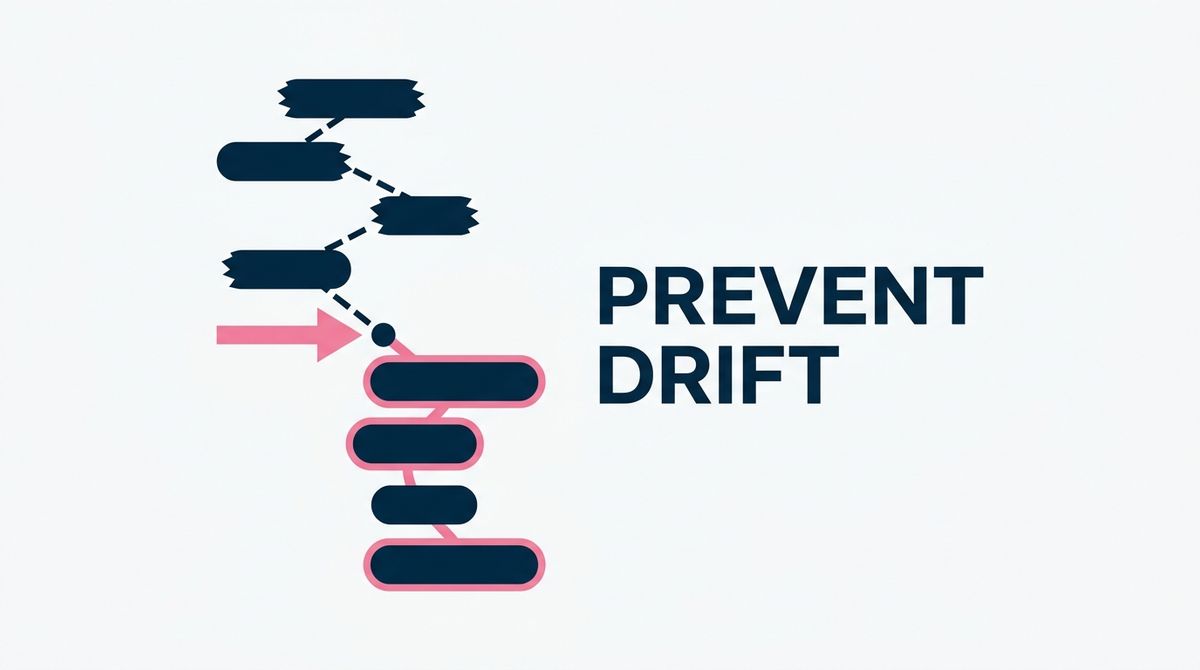
Imagine launching a customer service AI agent that aces every pre-deployment test. On day one, customer satisfaction scores tick upward. On day thirty, users are quietly abandoning the product. The engineering dashboard shows 100% uptime, zero server crashes, and lightning-fast response times. Yet, under the hood, the model has begun giving vague answers or hallucinating outdated details. The system is failing, but the alarms are completely silent.
This is the reality of AI Product Management. When traditional software fails, it fails loudly. You get a broken button or a 500 server error. The engineering team spots the bug, writes a patch, and deploys a fix.
AI products don't behave this way. They don't crash when they fail. Instead, they confidently return incorrect answers or slowly irritate users with subtle shifts in tone. This silent failure is the most expensive mistake an AI product manager can make. It happens when teams try to manage probabilistic systems with deterministic rules.
"An underqualified AI engineer produces a model that doesn't work," warns Chuks Anochie, AI governance expert and Co-Founder of DecIQ. "An underqualified AI PM produces a product that ships, gets deployed, functions confidently but degrades quietly, and eventually loses the confidence of the business." (source). This warning points to a massive gap in how companies build with artificial intelligence.
Why AI Product Management Fails in Production
To understand why this is dangerous, look at how failure modes differ between engineers and product managers.
If an engineer builds a poor model, the code fails to compile or latency spikes. The product never leaves staging. It is a visible, contained failure that spares customer trust.
But if an AI PM fails to understand probabilistic software, the consequences are worse. They sign off on a product that passed static pre-launch tests. On day one, users are happy. On day thirty, the model encounters new user behavior, the prompt drifts, and output quality degrades. Customers slowly abandon the tool while the business remains blind.
The asymmetry is what makes this hard. Engineering failures tend to surface before launch, where they're cheap. Quality failures in an AI feature surface weeks into production, and only if someone is set up to look for them — which is rarely anyone's explicit job when the feature ships.
Probabilistic vs. Deterministic Software: The AI PM Mindset Shift
PMs already stay with a feature long after launch — adoption, funnels, support tickets, the quarterly review. What's different with AI is the assumption sitting underneath all of that work: that the feature itself still does what it did on launch day. For deterministic software, that assumption holds. The button that worked in March works in July unless someone changes the code, so monitoring can focus on usage and performance rather than on whether the thing still behaves correctly.
This assumption is a trap when applied to LLMs. Deterministic software is built on logic. If input is A, output is B. We can write unit tests to cover almost every path. Probabilistic software is built on statistics. If input is A, output is a probability distribution. The model guesses the next token based on training data. We can't write a unit test for every possible prompt because natural language has infinite variations.
This mismatch leads directly to AI model drift. AI models exist in an ecosystem of constant change.
First, user behavior is unpredictable. People use messy, conversational language instead of structured inputs. A prompt that works in testing might fail when a user inputs a wall of text with typos.
Second, models are moving targets. Even with a pinned API version, underlying infrastructure changes. Subtle environment adjustments can alter performance.
Third, context drift is real. Over time, user topics change. A support bot trained on summer inventory will struggle when winter products launch, yet it will still answer with unearned confidence.
Example: A travel AI agent perfectly suggests hotels in July but begins recommending closed resorts in December because it lacks a seasonal feedback loop.
The New Mandate: Owning the Continuous Evaluation Loop
To prevent this silent slide, the role of the product manager has to change.
In traditional software, the PM defines the requirements and QA validates that the build matches them — a gate you pass through once. With an AI feature, correctness isn't a fixed property you can sign off on, so that gate has to become an ongoing measurement. In practice, the PM ends up owning an evaluation loop that keeps running in production, at the level of actual conversations.
This is not an engineering task. Engineers optimize for technical metrics like perplexity or latency. Only a product manager can decide if a model's tone aligns with the brand, or if a hallucination is catastrophic.
To bridge this gap, AI PMs must build three core competencies:
- Owning the Evaluation Loop
PMs must actively design and manage evaluation datasets rather than relying on engineering bench tests. This means curating a set of "golden prompts" representing real user scenarios and updating them with production data.
- Designing Data Product Strategy
A great AI PM treats incoming user conversations as a primary product asset. We need systems to capture user feedback, both explicit (thumbs up or down) and implicit (like copying an output), feeding this data back into our evaluation pipeline.
- Setting Probabilistic Success Criteria
We can't demand 100% accuracy from an LLM. Instead, PMs must define acceptable error rates, distinguishing between minor errors (like a summary typo) and critical failures (like fabricating a financial figure), then monitor these guardrails continuously.
- Retention and Silent Churn: When models fail silently, users don't submit support tickets. They simply stop using the product. By tracking silent failure rates against user retention, PMs can directly connect model quality to business revenue and prevent silent churn.
4 Steps to Implement Continuous Evaluation for AI
We must move from a static QA model to continuous evaluation.
Traditional testing happens before deployment. AI testing is a continuous loop running in production, which we call production evaluation.
Rather than running a test suite weekly, we must monitor production conversations in real time. This doesn't mean reading every transcript (which doesn't scale). Instead, we can use semantic search and automated evaluation to spot patterns.
Here is the tooling gap that many teams miss: traditional application performance monitoring (APM) tools like Datadog or New Relic are built for deterministic systems. They track server uptime and API latency, but they are completely blind to conversation quality and user intent. To see these silent failures, product teams need AI-native analytics and LLM observability.
To build this continuous loop, we recommend starting with four practical steps:
1. Establish a Baseline Evaluation Set
Before measuring drift, we must know what "good" looks like. Build a diverse set of 100 to 200 prompts representing core use cases, run them through your model, and document the expected outputs as your baseline.
2. Implement Conversation-Level Analytics
Uptime and latency are not enough. We must track user turns, identify where conversations go off the rails, and flag unexpected model behaviors like repetition or extreme length.
3. Automate Your Evaluation Pipeline
Manual review doesn't scale. Use automated evaluators to grade production samples against your criteria, checking for issues like hallucinations and safety violations to get an early warning of drift.
4. Feed Production Data Back Into Development
The best evaluation sets use real user interactions. When you identify a conversation where the model failed, add it to your evaluation set to guarantee the model doesn't repeat the mistake in the next release.
Most specs describe exact behavior. A button does one thing and you can write that thing down. With an AI feature you're specifying boundaries instead — what the model is allowed to do, how it should sound, what counts as out of range — and the specific output stays outside your control. That's a real change in what a spec can promise.
This requires a mindset shift. Instead of asking if the product is 100% correct, we must ask if it is performing within acceptable quality boundaries over time.
Without this shift, AI projects will look amazing in demos but fail to deliver business value. The companies that win will succeed because of their feedback loops, not the size of their models or engineering budgets. They will spot degradation first and fix it fastest.
Frequently Asked Questions
What is silent degradation?
Silent degradation occurs when an AI model's performance slowly declines in production without triggering traditional system errors or server crashes. The product continues to run and return answers confidently, but those answers become less accurate or off-tone over time, leading to silent user churn.
What is the difference between probabilistic and deterministic software?
Deterministic software follows strict logic where a specific input always produces the exact same output. Probabilistic software is built on statistical models where the same input can produce different outputs based on probability distributions. This makes probabilistic systems highly flexible but susceptible to drift and unexpected behaviors.
The Bottom Line
The transition from deterministic to probabilistic software requires a fundamental shift in how we manage products. AI PMs cannot rely on static pre-launch testing to guarantee quality. To prevent silent degradation, product teams must build continuous, conversation-level evaluation directly into their production lifecycle.