Braintrust Pricing vs. the Alternatives: What Full Trace Coverage Actually Costs
 Itamar Kramer8 min read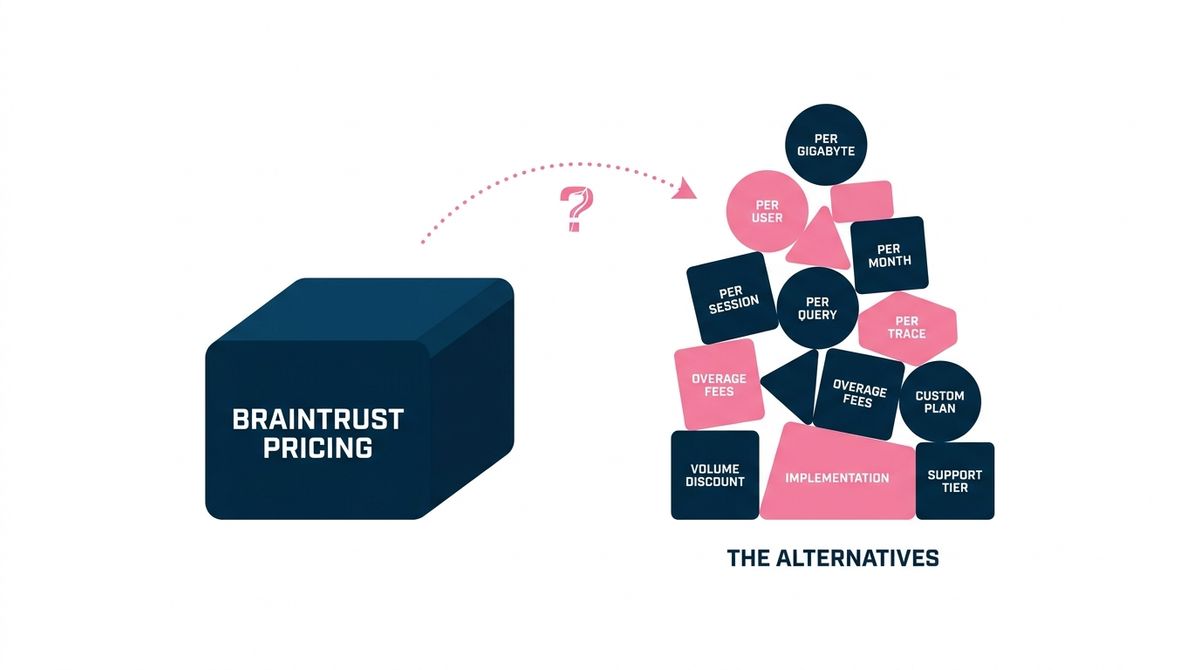
Every comparison of LLM observability platforms runs into the same wall. Braintrust charges per GB of processed data. LangSmith charges per seat and per trace. Langfuse charges per unit. Arize charges per span. Confident AI charges per GB-month. Five platforms, five different things being counted, and no way to line up the headline rates.
So most people compare the wrong number, pick on it, and find out what the platform really costs about four months later when the agent is carrying real traffic. This post lays out what each platform actually meters, as of September 2026, and how to build a number you can trust for your own volume.
Braintrust Pricing: Three Meters, Not One
Braintrust is usually quoted as "$3/GB," which is true and incomplete. That rate is the Pro-plan overage on processed data, and processed data is only the first of three things you pay for.
- Processed data: $249 per month on Pro, including 5 GB, then $3/GB. The free Starter tier includes 1 GB, then $4/GB. Braintrust defines processed data as everything ingested across logs, experiments and datasets, which covers traces and spans along with inputs, outputs, prompts, metadata and attachments. It is measured at ingestion, monthly.
- Scores: metered separately. Pro includes 50,000, then $1.50 per 1,000. Starter includes 10,000, then $2.50 per 1,000. Every recorded score increments the count, so a trace graded on four criteria costs four scores, not one.
- Retention: Pro holds data 30 days (Starter 14). Keeping it longer costs $0.50/GB per month, charged on an ongoing basis rather than once.
The reason this matters is that all three meters move together. More traffic means more bytes, more scores and more stored GB in the same month. A volume estimate built on the ingestion rate alone will land low, and it lands low by a larger margin the more of your traffic you actually grade.
What the Alternatives Charge For
- LangSmith bills seats and usage. Plus is $39 per seat per month with 10k base traces; usage past that is metered in LangChain compute units ($1.50) and storage units ($1.00). Base traces are retained 14 days, extended traces 400. The seat component means cost scales with team size as well as traffic, which no other platform here does.
- Langfuse bills units. Core is $29 per month and Pro $199, both including 100k units, with additional units at $8 per 100k and volume discounts beyond that. Retention is 90 days on Core, three years on Pro. It is also open source and self-hostable, which is the only option here that lets you take the per-unit meter off the table entirely and pay for infrastructure instead.
- Arize AX bills three things too. Pro is $50 per month covering 50k trace spans, 10 GB of storage and 25 signal issues, with 30-day retention. Evaluations, experiments and human annotations are unlimited on every tier, which is a genuinely different shape from Braintrust's per-score meter.
- Confident AI bills GB-months. Starter is $200 per month with 5 GB-months of trace spans, Team is $2,000 with 75, and overage on both is $1 per GB-month ingested or retained. A GB-month is not a GB of ingestion: the same gigabyte kept for three months counts three times. Comparing that $1 against Braintrust's $3 as though they were the same unit is the single most common mistake in this comparison.
How to Build a Number You Can Trust
There is no shortcut that avoids measuring your own traffic. Three inputs decide almost everything, and you can pull all three from a week of existing logs:
- Sessions per month, and spans per session. Multi-step agents are the reason this comparison is hard at all: a single session that calls four tools and makes six model calls is not one unit of anything.
- Average bytes per span, measured rather than guessed. Prompt size dominates this, so a RAG agent stuffing 8k tokens of context into every call produces a wildly different bill from a thin function-calling agent at the same span count.
- Scores per trace, times the share of traffic you intend to grade. On platforms that meter scoring, this is often the line that grows fastest, because it is the one teams increase deliberately as they get more serious about quality.
Take those three numbers to each vendor and ask for a quote at that volume with a scorer running on all of it. The answer will not resemble the pricing page example, and the gap between the two is the actual thing you are choosing between.
Four Things That Distort the Comparison
- Scoring priced as a separate meter. Where grading costs extra per score, the cost of quality work rises with the amount of it you do. Worth pairing with an honest look at which scores earn their keep, since high eval scores can fail your AI roadmap while costing you on every trace.
- Retention windows buried in the plan. A 14- or 30-day default looks free until you need to investigate a regression that started six weeks ago. Extended retention is a recurring monthly charge on the stored volume, not a one-time fee, and it compounds.
- Seats, where they apply. Per-seat pricing is cheap for a team of three and a real line item for a platform org of forty. It is also the one cost here that has nothing to do with your traffic.
- The cost you pay by sampling. The usual way teams control all of the above is to keep 5% or 10% of production traffic. That shows up as a lower invoice and never shows up as a line item, but sampling fails AI agents for a specific reason: agents fail in probabilistic, low-frequency ways, so the runs you most needed to see are exactly the ones a sample drops. Any cost comparison that comes out favorable because you sampled has moved the cost somewhere it cannot be counted.
What Each Pricing Model Moves With
Every platform here can technically ingest 100% of your traces, so what each pricing model really tells you is what your bill does as the agent gets more complex. Per-GB models move with prompt size: add retrieval context and the cost rises without a single extra conversation. Per-score models move with how thoroughly you grade. Per-seat models move with hiring. Per-span allowances move with how many steps your agent takes to finish a job, which is the one that surprises people, because that number tends to grow as the agent gets better rather than worse. Self-hosting Langfuse takes the meter off altogether and gives you infrastructure and ops time to run instead. None of these is cheaper in the abstract. They fail in different directions, and the one to avoid is whichever fails in the direction your product is already heading.
Frequently Asked Questions
How much does Braintrust pricing cost?
As of September 2026, the Pro plan is $249 per month including 5 GB of processed data, with overage at $3/GB. The free Starter tier includes 1 GB, then $4/GB. Scores are metered separately, at $1.50 per 1,000 on Pro after the first 50,000. Retention past 30 days costs $0.50/GB per month. Your real bill is the sum of all three, not the ingestion rate on its own.
Is Braintrust more expensive than the alternatives?
It depends entirely on your shape, and anyone answering this without your numbers is guessing. Braintrust's per-GB model punishes large prompts and heavy scoring. LangSmith's per-seat component punishes large teams. Arize's span allowances punish chatty multi-step agents. Confident AI's GB-month model punishes long retention. Langfuse self-hosted moves the cost into infrastructure and ops time. There is no ranking that holds across all of those.
Why can't I just compare the per-GB rates?
Because most of these platforms do not bill per GB. Where two of them appear to, the units still differ: Braintrust's $3 is per GB ingested in a month, while Confident AI's $1 is per GB-month, so a gigabyte held for three months counts three times. Convert everything to monthly cost at your own projected volume before comparing anything.
The Bottom Line
Headline rates on this category are close to meaningless because no two vendors count the same thing. Measure sessions, spans per session, bytes per span and scores per trace from a week of your own logs, then get quotes at that volume with grading turned on across all of it. The platform that wins that comparison is rarely the one with the lowest number on its pricing page, and the difference is usually large enough to matter more than any feature on the list.